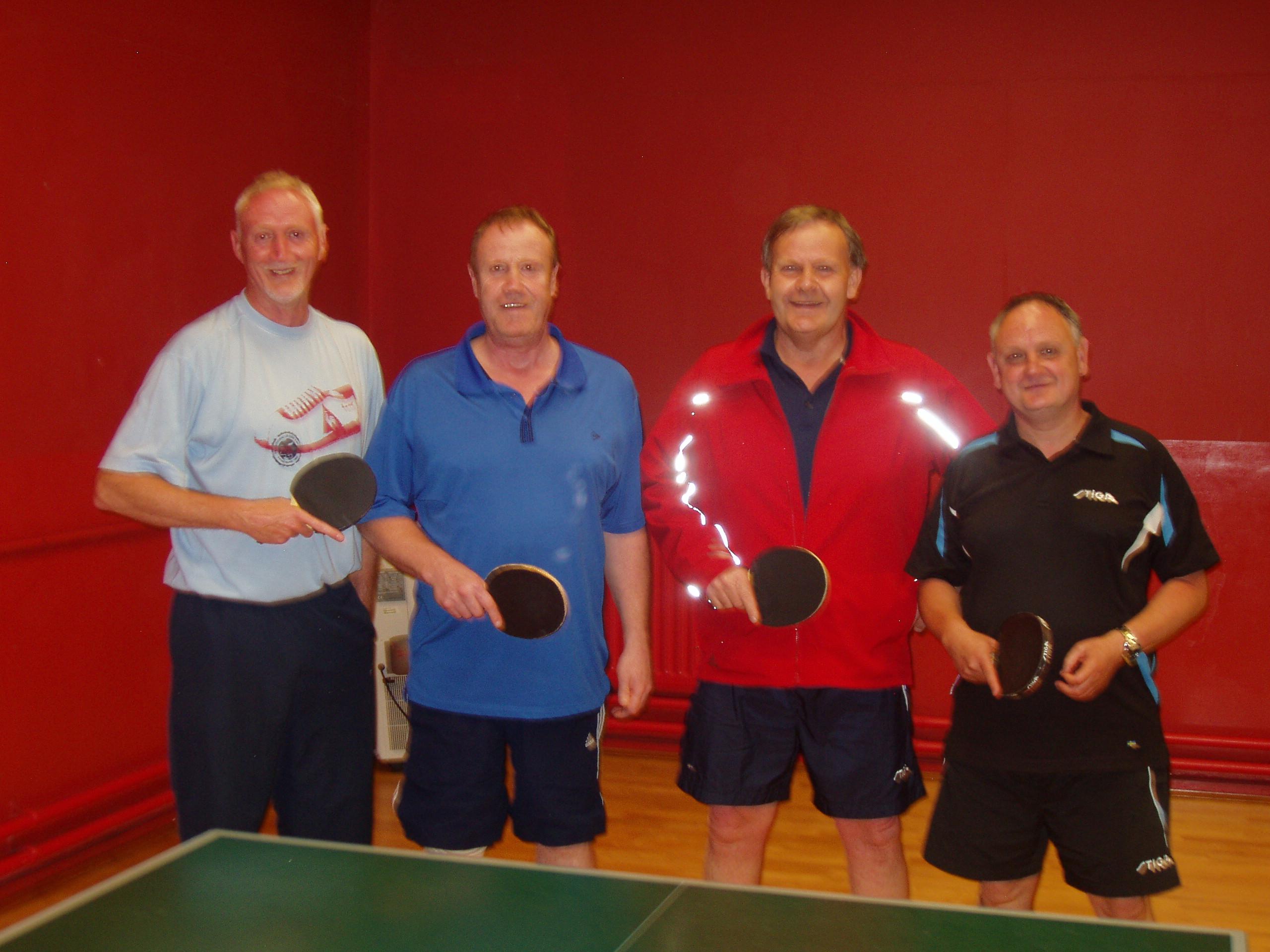
Turban Sikhs and Destroys

turban

Premier Division: Nomads ‘A’ 2 Ramsbottom ‘A’ 7

Nomads’ Billy Russell and Keith Dale weren’t to know that teammate Frederic Turban would turn over the league’s numero uno scalp, Michael Moir. They were already in the doldrums – 7-1 down on the night; Russell and his colossal thighs departing early due to coaching commitments and Dale probably stricken by the grief of ‘playing up’, albeit in respectable four-set matches.

Should the ‘85th’-minute leavers be castigated though? Should they have stayed to watch the night’s final match between the no.1 seeds? Yes – most definitely. And Turban, who did something only Louis Rosenthal has done since the league’s current electronic records began in 2011 – namely, beat Moir – seemed to feel the same, although he was too polite to say so.

Asked whether he felt pumped up after the victory over Moir (8-11, 11-5, 12-10, 11-7), his words were a little mournful: ‘Sad that no one in my team was there to witness my game against Mick but that is life. I know I achieved something that probably few do. I arrived in the Premier in 2012 and three years later I beat Mick. I still know I have to practise hard to beat him again, but at least I am on the right path.’

To put into context Turban’s triumph, Moir (85th ranked in England) before starting this fifth season -as archived by tabletennis365.com – had won 212 of his 213 matches. Only Rosenthal had upset Bolton’s table tennis lion and in much tighter circumstances (10-12, 11-9, 11-9, 11-7) in what was frustratingly Moir’s last match of the 2013/14 season.

Given that it is so early in the table tennis calendar, was Moir rusty? Were outlandish and freakish gremlins at play in what is typical of September battles across numerous sports? Such analysis is very doubtful. Turban simply figured Moir out. ‘His serves did not bother me at all and I could return without putting myself into difficulty. I think this changed Mick’s game as he had to work on the third ball.’

Turban, a steady Premier player, but with a win percentage in this division that is noticeably improving (26% 2012/13, 46% 2013/14, 51% 2014/15), is an example of what can happen when a player in the middle rankings meets a top player; French flair intervenes.

Born in Semarang, Indonesia but with 20 years of France inside him – plus a bit of Thai spice and English mustard – Turban’s time has possibly come.

* Article headline courtesy of Bury amateur cricketing legend, Matthew Metcalfe. This article will appear in The Bolton News on Tues, 29th September 2015.

Twitter: @jeffweston1970


Unedited and unabridged interview with Frederic the Great

fred great

1)      Since electronic records began (Bolton League) in 2011/12, Michael Moir (currently 85th in England) has got 100% in three of those four full seasons – his only loss to Louis Rosenthal in March 2014. That does make your recent victory against him special.
Would you say he’s seen as the biggest scalp in the league? And who comes after him in terms of scalps (say, 3 or 4 others)?

It is always a satisfaction to beat a player as strong as Michael. Due to his statistic he is indeed the biggest scalp in the league and I am sure it will take me other try to beat him again.
Before him, I had some great win against player like Barry Elliot, Andy Jackson, Mark Ramsbottom and others since I join the bolton league in sept 2010.

2)      The only times I’ve previously mentioned you in Bolton News articles, Fred were in June 2014 (“Barber plying his trade against relative unknowns including Frederic Turban” –https://thesportswriter1.com/2014/06/03/step-into-the-barbers-chair/) and earlier in October 2013 (“Riley edging past weaker opponents, Kaye and Turban” – https://thesportswriter1.com/2013/10/03/blimey-oriley/). Do you think NOW is finally your time?

I dont know if it is my time, but i am surely starting to put my name in the league.

3)      How is it possible to lose Andrew Jackson but beat Michael Moir? When you lost to Jackson 11-5 in game four was there any sense that it was still going to be a good evening?

Probably the French flair 🙂
That night I was in a good shape, full of energy and it was the second match of the season. Plus my back was not hurting (i have ankylosing spondylitis), so anything could happen that night.

4)      Your WIN %age over the years has been: 76% (2011/12 Div1); 26% (2012/13 Prem); 46% (2013/14 Prem); 51% (2014/15 Prem). Steady progression in anyone’s eyes. What are the key shots / things / tactics you’ve learnt over the years?

Throughout the year my game has improved both technically and physically. My game is mainly based on my serve and force myself to open the game by looping the ball and try not to make many mistake. The downsize is that I struggle against player that have pimple because I cannot use most of serve.

5)      Did you feel pumped up driving home after the Moir victory or were you chauffeured back home just in case the excitement proved to be too much for you? Was the feeling comparable to any other big victories in recent times?

I drove home by myself. It was a mitigate feeling. I was happy to beat Mick and Brian, bringing 2 points against ramsbottom A is a good result for the team. Sad that no one of my team was there to witness my game against Mick but that is life.  I know I achieve something that probably a few did. I arrived in premier in 2012 and three years later I beat Mick. But I still know I have to practise hard to beat him again but at least I am on the right path.

6)      You talked about the 3rd shot with Moir (when his serves didn’t come off). Were there any particular tactics before the match from you? You must have studied him to a degree? Some players keep notes on other players, some know weaknesses/strengths from memory. How do you work?

Mick has a very effective serve and his arm goes fast.
That night, he played against Billy and Keith. I had time to look at him play, he scores a lot of points after his serve. So my main focus was to return his serve and play my game. I remember I put a lot of effort and concentration reading his serve and that night he paid off. Next step would be to reduce my attention on his serve and go by instinct.
I don’t keep note against players. I remember most how I loose a game rather win the game. I just try to remind myself how I should play : stay close to the table, return the ball at all cost, dont rush on it, stay in balance, counter , varied serve and above all have fun.

7)      I see that you only played Moir once last season (a 10-12, 10-12, 5-11 loss in September) as he didn’t turn out in January for Ramsbottom. Was that match of sign of things to come? i.e. the close 10-12s. Did you learn anything for the big match one year later?

I learn a lot by playing against Mick. He makes things very simple and could change the pace in a flash. He can play “relax” for couple of points and when its matter he scores. He is technically still far ahead from me. After it is question of opportunity. I learn when playing against him is that I can score direct point with my serves, that I had to work on my footwork and consistency to have a chance to do some rally against him.

8)      Coaching with Billy Russell – how is that working out? Any others influences / help in your life on the table tennis front?
It is true I played a lot with Billy. Probably because we both like to practise and there is no doubt he help me a lot to reach this level of game.I improved technically a lot with him as he is not very easy to play against. In the league there are players that have help me to tweak my game like Phil Riley, Dennis Collier, Ronnie Durose and Charles Musa. There inputs are valuable, after I just have to find a way to apply them on game.  Of course indirectly all the opponents I played against have shape my game..

9)      Last season you beat certain players of note including Andrew Jackson, Edward Simon, Brian Clements, Phil Riley, Barry Elliott (& possibly Michnowiec – maybe not as he forfeited / story behind this?). Which match felt the best and why?
They were all great win. These players have different style and I had to play differently to beat them. I did not beat Michnowiec If i remember there was a technicality issue. Last season I think the best win was against Mark Ramsbottom. Mark has pimple on his backhand and I struggle against this type of rubber. He was leading 2-0 and I manage to come back and beat him on the 5th.
He won the first two set. The third set was very complicated, I won it but very close. Then the 5th was very tight, I remember winning the last point on my serve.

10)   In Jan 2015 you slaughtered Andrew Jackson 11-3, 8-11, 11-4, 11-4. What was different this time around?
Andy is a strong player and very consistent. I did not manage to take the upper hand on the short game. I probably played too much on his backhand, too much on the middle of table and I fail to take initiative. So I still have a lot of work to do to beat him.

11)   Colin Boardman (Burning Desire) – doesn’t have a younger brother called Stephen does he?
I am the wrong guy to ask this question. Is the rider Chris relates to Colin?

12)   When (month/year of birth) and where were you born?
January 1976, Semarang Indonesia

13)   How did you get into table tennis?
I start to play with my dad for fun. And then I take really interest in table tennis at 16years old in France when the was some school competition.

14)   Did you aspire to play in the Premier Division or higher?
I always try to do my best  and like challenges.

15)   Your team have finished…7/12 (2014/15), 9/12 (2013/14), 10/11 (2012/13) – in other words a steady improvement each season. Do you see a top 4 finish over the next two to three years? Any big signings planned or loyal to the current team?
For this year I hope our team will maintain on premier and it will be great if we can reach 100points at then end of season. To be on the top4, I think a team need at least 4/5 consistent players (average >60%).

16)   Do you think Flixton represent a challenge to Ramsbottom this season for the title? Yes/No and why?
These two teams have a strong squad and will be still in front. I hope we can play the role of party pooper to spice the league.

17)   Have you ever been headhunted for another team?
Not in the bolton league.

18)   What does table tennis mean to you? Is it your main sport and how many hours/week would you say you put in?
I played before several sport like football, volleyball , basketball, track n field, martial arts and finally table tennis. Table tennis is a very convivial sport and reflect your personnality. The way you play define who you are. Beside the technical, physical aspect of the game, the mental plays an important role during the game. I was fortunate to took part in several aspect of this sport and at different level. I coached the cadet/junior Brittany team, I was a referee in several national tournament and organise several regional tournament.
It is currently my main sport and I try to play twice a week.

19)   What is your daytime job? Is it fulfilling?
I am a Software Engineer. I am not complaining .

20)   Which players do you respect most in the league and why? Anyone’s style you seek to mimic?
I can say that I respect every players in the league. I think it is my personality. There are some stroke that I would like to do or have like Brett’s backhand or Barry’s or Ben’s forehand hit.

21)   Hardest venue you’ve played at? Where have you travelled to play the sport?
Due to my back there are venue that I cannot play freely because there is no space or the floor is tricky, like Heaton or Little Lever. In these venues I know I have to change my game style and concentrate on how I should move.
 

Longworth Stock Surges

surge

Division Two: Harper Brass ‘C’ 6 Ladybridge ‘B’ 3

The real hero tonight was not the winning team, Harper Brass C. Nor was it the players inside it – captain Faizan Bhura, Kirit Chauhan and treble terminator John Nuttall. It was instead Ladybridge’s stand-in player from Division Three, Ellis Longworth.

The 15-year-old lad with the wedge haircut and lanky legs lost all three of his matches, but one must look inside that raw number just as a humanist studies the bereft GDP figure that is an economist’s Holy Grail.

Versus Bhura: 11-5, 7-11, 8-11, 11-7, 9-11 (46 points to 45 but still the loser). Against Nuttall: 8-11, 11-13, 11-6, 9-11 (savage). When entertaining Chauhan: 4-11, 8-11, 4-11 (head understandably gone).

You play twelve games, you usually deserve something. You rock Nuttall 11-6, people sit up. To look at Longworth, you do not initially spot the majestic player. There are the private pet talks muttered serenely: ‘Come on, Ellis’ (like a whining call to the gods). There are the occasional, soft-trickled shots into the net.

He could be a six-foot rake in the corner of a garage, a Pale Rider but what he probably is is Keir Hardie walking into Parliament as an MP for the first time in August 1892; unperturbed, courageous, a fighting man not dragooned by protocol and reputations.

How ironic that hours before this exalted performance Longworth was grounded from school for wearing “unacceptable” shoes. The world of table tennis has no such piffy rules – merely that playing shirts and shorts are “of a uniform colour other than white”.

Given that Longworth had to borrow a bat for this clash (his preferred blade locked in the house of his usual teammate) and was of course ‘playing up’, his exploits were remarkable. Ask Xu Xin to use the bat of Ma Long. There would be a look of disgust, the clear recognition that one’s normal game would be compromised.

Longworth did not tangibly assist his temporary teammates, Brian Greenhalgh and John Cole in their annual quest for survival, but his hard-hitting, accurate forays surprised many. Greenhalgh’s range of expressions on the court and self-criticism (“Fingers …Oh, you plonker…Frilly underwear”) – despite his double – could be said to embody this. And Cole’s renewed impetus was arguably due to the gee-up of the younger competitor and colleague.

As for Harper Brass – this was a good win, but they must start talking between games. Bhura’s two losses could have been avoided with a canny word or two from his elders.

* This article will appear in The Bolton News on Tues, 22nd September 2015


Spinners and Steel Benefit from Top Teams’ Exodus

Image result for exodus pencil drawing

A perfect 60 teams in the Bolton Table Tennis League was never going to last. Scurryings down the road to Bury, retirements and the odd AWOL during a summer of madness were always going to unhinge things slightly. The consequent pain has fallen on Division Two in that following all the shuffling around the middle division has been left with only 11 teams; two scrubbed fixtures from the normal list or “open dates” as the committee like to say.

Table tennis widows will rejoice such an outcome – plan that extra line dancing class or add grim tasks to the infamous ‘jobs list’. But it is the peculiarity of having at least half a dozen teams in Division Three that could legitimately turn over their higher rivals that now piques. Rarely have so many teams been promoted from lower down the league – the traditional two per division swelled to four and five including fragmented sides.

The scars are evident and there will be some cup ‘shocks’ as a result. A point in case is the group of teams that finished fourth to seventh in 2014/15: Harper Brass B (112 points); Farnworth Social Circle C (110); Hilton J (108); Boyzone (107). A mere five points separated this cluster of teams, yet only Harper Brass B have been given a golden ticket to the Division Two funfair. Perhaps shamed into anonymity they have subsequently changed their name to Top Spinners. Are they the luckiest team in the world?

‘I found it strange that the Heaton team that finished bottom of Two were relegated while the team that finished fourth in Three were promoted. Maybe the Heaton team had had enough,’ a player who wished to remain anonymous commented.

There is a reason for this and it comes straight from the General Secretary, Roy Caswell’s lips via a bit of paraphrasing: The committee felt that those teams which were so far away from the pack that it would have been absurd to keep them afloat in the same division were relegated. Given that Heaton were 61 points from the official safety line this seems credible.

As for the charmed and blessed a fleeting examination of Division Four’s final table shows Irlam Steel massively off the pace in third – a full 45 points – behind the kids and Poles of Harper Brass D and Polonia but waved through.

No solution is ideal in these circumstances but sufficed to say Bolton will unfortunately be a weaker league in 2015/16.


Tim Vaughan: The Five-Set Man

vaughan long matches


‘Truth is going out of fashion,’ Nomad’s Tim Vaughan tells me. I had phoned him to ask if he had any ideas as to why his table tennis matches last longer than anyone else’s, why he has an extraordinary amount of five-setters under his belt and before I knew it he was talking about pianos, community painting and self-education.

I don’t mind a bit of discursiveness, a few Woody Allen non sequiturs, but sometimes I need the facts fast – quotes to shape a story, relevant background information and insights.

This was meant to be a simple pick up – a collection of words from a player which I could massage into a short article. Match Secretary, Brett Haslam had warned me beforehand, however: ‘I think if your two brains come together there’ll be some sort of Hadron event.’

Vaughan was going to be difficult – like talking to a Mastermind contestant or a Frenchman. Nothing was for free. Being on the phone for less than 20 minutes was incomprehensible to him; five minutes a mere pulling out of the station, 10 minutes a slow unscrewing of the flask top. Hang on tight for the journey!

Vaughan is a rarity among table tennis players. He is a multi-layered man – one of only two I have met that like to sit around the camp fire and mull over life. The record for wordy responses is currently 2,400 held by Flixton’s Paul Cicchelli following an interview with him. After much to-ing and fro-ing, Vaughan claimed to be sat on a stash of 5,000 words prompted by twenty questions I had put to him. He had apparently doubled the ante.

Why did I want answers and riffs from this Ashton resident (Liverpool born in 1963)? Why did I seek critical facts underpinning his game?  Because his stats were staggering. Normally a player is lucky to reach 25 per cent in terms of five-set matches participated in throughout the league season. This Division One player was off the scale at 42 per cent. A bounteous 24 of his 57 matches in 2014/15 were sweat-inducing marathon sessions.

It was uncanny – almost as if Vaughan wanted or needed plentiful ding-dongs, as if the whole thing was staged. But who in their right mind prolongs things?

Perhaps it is not within him to be merciless. But then fellow players applaud his technique: ‘He reads people’s games, plays close to the table with a good natural style, attacks very quickly on both flanks and takes spin easily.’

The 5000-word haul never arrived. Maybe it is Vaughan’s attempt to indemnify the truth. Maybe a larger piece on him will follow.


Fleetwood Town – Running out of Coke and Crisps?


Fleetwood Frazzled: Town 0 Burnley 2

There was something of the office world in this performance – bland, mechanical, without real invention. Meeting a team two divisions above you (based on 2014/15) is clearly a hard proposition but Fleetwood offered little by way of hunger, impromptu football and penetrative guile. Continue reading Fleetwood Town – Running out of Coke and Crisps?

The Return of John Nuttall

Image result for whirlwind pencil drawing

Special signings are rare. They reinvigorate a club. They act as polish to the existing ranks.

The news that The Lostock Lasher, John Nuttall is considering a return to table tennis after temporarily retiring in March 2014 is significant indeed. There are not many with his thirst, his drive, his sublime, unorthodox technique.

Past reports have lauded him – taken note of his ability to constantly win (“No Stops Yet for Nuttall Steam Train”). In 2012/13 he did the impossible – he won all 57 of his league matches and joined a select group, the ‘100% Club’.

So where will the 24-year-old play? What contracts and promises have been texted, verbalised and emailed to this still young man with the settled mind of a 35-year-old sage?

Discussions have been had with Meadow Hill, Harper Brass and Heaton to date. When a conqueror hits the market, there is no shortage of takers, no feigning disinterest or stroking one’s chin.

Who will land him? There are sticking points to a deal with each club. Meadow Hill, captained by league general secretary, Roy Caswell finished the 2014/15 season in 11th place in Division Three – one of the relegation spots. Should their logical fate play out then a Division Four birth will not be attractive to a player that has gone unbeaten in the league’s bottom division and has actually achieved 96% in Division Three.

Harper Brass offer a natural route forward having been promoted to Division Two, but team loyalties – still beating in some quarters of the UK – will prevent such a transfer…for now. Their squad is full and ripe and very few teams desire a dressing room of five players when only three walk the table. A perfect fit it would have been, but its time may come again in 2016/17 with an anticipated restructuring of the Harper stable.

Heaton then – that little cricket club on the hill which offers great bar facilities, limited parking and alternative sports. The irony here is that Nuttall’s last tormentor, Dave Jones Snr plays for them. The 16th January 2014 remains etched in both players’ heads. Could the old enemy merge, join forces? It is more than likely. Dave Jones Jnr, of the same club, is a long-time admirer of Nuttall and understands Heaton’s deficiencies following relegation from Two to Three.

Concerning the man himself though – Nuttall’s words say a lot: ‘The main thing I want to do is play with people I like and know.’

A simple wish, but the wish of a force, a table tennis whirlwind.


Summer League Final 2015: No Golden Gun

OLYMPUS DIGITAL CAMERA

Coburg ‘B’ 12   Coburg ‘A’  8

A blunt analysis of this final would posit that Mark Speakman of Coburg ‘B’ was the principal architect in demolishing higher lettered rivals, Coburg ‘A’. His personal points tally for the evening was 6 ½ set alongside team mate Bob Bent who hauled in a point less (opponents Kevin Chapman and Jim Hewitt accumulating 5 ½ and 2 ½ respectively).

Such a hard hearted study of what was actually a torturous and psychologically waning experience would fit many a Tory budget, yet numerous facts must be combed over in order to unearth the deeper story.

Displaced champion, Wilson Parker (one half of 2014 winners Ivory Toasters) was seen leaving the Hilton Centre shortly before 9pm which said much about his altruistic side – choosing to partner his father at this year’s event – as well as his burgeoning talent. In the spotlight tonight, however, were players that had topped their leagues with 126 and 112 points and in the process formed an almost-inverse reality to their spluttering Premier Division season.

Whether this competition can be deemed a blue-ribbon event is open to argument but it does undoubtedly instil vast quantities of goodwill, happiness and camaraderie.

Take Speakman, first out and brimming with black Stiga attire and a dapper silver watch. He is one of the shortest men on the circuit but not short on bounce. There is a rapscallion nature to his blunderbuss shots. Rarely does he aim for the body – choosing instead to confuse his opponent with angle after hard angle. And yet he is complimented – particularly by Chapman: ‘You’re playing well, pal…Well done, you deserved that.’

Against Hewitt (wearing blue, right knee bandaged, hip a little sore), there is a cautious air. Stats suggest that pimple-wielding Hewitt is the better player but the heavy-timber hitting of Speakman wins through 11-8, 11-5, 11-6. There is a slight triangle at the front of Speakman’s grey/black mop; Bermuda to Hewitt.

The inimitable Bent steps forth. He wishes to consolidate Coburg B’s 3-0 lead. Tibhar trainers and an admirable reluctance to defend send a shudder throughout the hall. The first game goes to plan (11-5) but then the big-cranking Chapman in navy Reebok pants starts to play. How do you describe this man? When he misses, it is in the form of air shots and wild, wild loopers that pound the back wall. But when the fire rages and you witness the ripping ferocity of his top spins it is a delight.

There are few players who throw their whole bodies into shots so mercilessly. Chapman (finely-trimmed white goatee and lime-striped Asics trainers), to the part-timer, can seem average, duff even. To the aficionado, however, certain thoughts resonate: Just wait for the trailers to end. Soon the film will start. Soon the Kev-Meister will have you tucked in your seat.

4-11. Bent is wobbling. 2-7 in the third; a ridiculous net climber from Chapman, but then that is the joyous momentum of a top spin. Bent is thinking, thinking – what to do, how to turn this around. Determined, gritty, his stocky arms manoeuvre the bat in the manner of a Frisbee. 7-8. 11-8; nine out of ten points. ‘I sat back,’ Chapman tells himself.

It is noticeable that Chapman regularly holds leads and then somehow gifts the game. With Bent down 6-10 in the fourth, Professor Crank nearly blows it again but brings it home 9-11. You then see him wipe his right hand on the wall before the final game. Who is this man –the air shot king or a mercurial legend that basks in his intuitive ability?

1-5 in the fifth suggests the latter. Chapman is in the ascendency – countering Bent forehands. No feeble ending this time. He holds firm: 6-11. The evening is getting interesting. It is now 5-3 to Coburg ‘B’ on the night.

The doubles brings with it a bit of gung-ho fun. Gone is the discipline and strategy – a little like the scorecard which has been played in reverse order. “Super Kev” I scribble down. He has done it again – assisted by Hewitt. Coburg ‘B’ fall: 12-10, 8-11, 10-12, 5-11. Half a dozen points each now. And it is crunch time with the savoured penultimate match between Speakman and Chapman.

Put these men in to various sports and you would get a different result each time. One is squat yet powerful, the other lithe and rangy. If you want a wicketkeeper then Speakman is your man. If you want to shoot a few basketball hoops, have a word with Chapman. Each brings to the table a set of flavours though. Each manifestly soaks in the table tennis arena and all that it means to the men with bats.

Chapman starts well (he always does). Speakman trails 2-7 in the first. Before the serious stuff, Chapman had asked ‘Are you warm enough, Mark?’ Strictly speaking, he is part of Jim Hewitt’s vast network of contacts within the game, but tonight the amiableness stretches further – even to the enemy. Speakman appreciates the gesture but thoughts of such pleasantries coming back in kind via his play suggest a serious miscalculation. 5-7. 11-9; Speakman’s cushioned shots seemed to disturb the Chapman rhythm.

As a spectator your eyes change. You screw them up watching live bombardment from both sides. Some matches entertain. Some matches allow distractions. This is definitely the former. 9-11. 12-10. It really couldn’t be tighter, but Speakman has the edge, a gruelling, self-imposed schedule. He is playing for the non-existent cameras, the scattered crowd, the small-time journalist sat opposite the umpire.

Before the fourth game a gallon of chairs clatter. Things are being cleared away. Other matches are ending. But this…this feast continues. NO SPECIAL TREATMENT HERE. That should be the message to all. You are in a final, but don’t expect a red carpet, don’t expect peace. Such demands are ridiculous – necessary and understandable, but alas ridiculous.

‘Watch the serve!’ Chapman berates himself with at 4-4. He then creeps along, forges a 6-8 lead, but Speakman is still gunning, still faithful to his forehand/backhand switch. A net point skids low along the surface and it is 8-8. You look at them now – both faces – and just know that Speakman has it. The smashes, the unsuppressed toil – the sweat on that slightly wrinkled head. 11-9. We are at 9-7 on the night – ‘B’ still dominant, still bigger, partly mocking the anomie ‘A’.

Measured play emanates from the table now frequented by Bent and Hewitt. 7-9 in the first and words trickle from Jim’s laidback mouth: ‘Come on – this one.’ As soon as he says it though, bad luck enters, it chews him up, it demoralises him and feeds him to an invisible slayer. 11-9: Bent in control and the evening so nearly beyond Coburg ‘A’.

7-10: Another winnable position for Hewitt. But something about his cute placements and his reliance on opposition errors doesn’t stack up. The man with the gold tooth needs a golden gun. He needs to fling himself over the line, but with a dicky hip and knee that isn’t easy. 10-10 and his first expletive of the night surfaces: ‘&*^%$£”(!’  Surely not again? Does he keep chucking it away or is Bent a fighter? 13-11: a fighter. ‘Good serving,’ Hewitt concedes.

It is 11-7 to Coburg ‘B’ and so the rest is academic – like a cheap examination paper, like a bad meal at a Berni Inn.

2-11: too late Hewitt heroics. 11-7: Bent with that serve variation – a maker of pancakes and scrambled eggs (bat as pan, ball as egg).

Hewitt’s woe is ours. Chapman’s disappointment is ours (the man from the table tennis maths lab who studies probability). Hats off to Speakman and Bent though – a 12-8 team victory achieved at 10.25pm and some compensation for their torrid season in the Premier Division.